
The Uber ChatGPT Work rollout is one of the biggest enterprise AI deployments announced this year. Uber confirmed on October 22, 2026 that its entire global workforce, about 30,000 people, will now use ChatGPT Work, OpenAI's AI agent built for businesses. The move follows a pilot with 1,000 employees earlier in the year.
For anyone tracking how large companies adopt generative AI, this is a useful case study. It shows a company moving from a careful test to full access, without first locking down exactly how every team must use the tool.
What Is ChatGPT Work and Why Did Uber Choose It?
OpenAI introduced ChatGPT Work in July 2026. It is an enterprise-focused AI agent that teams can point at real workflows, not just a chat window for one-off questions. It can analyse data, draft content and build simple tools on request.
Uber says OpenAI worked closely with its teams on integration. That matters, because the hardest part of enterprise AI is rarely the model itself. It is connecting the model to company data in a safe, useful way.
Inside the Uber ChatGPT Work Pilot
The pilot gave ChatGPT Work to 1,000 staff across finance, operations, product and other departments. The surprising detail is who used it. According to Uber's VP of engineering, Sumanth Sukumar, roughly 80% of early adopters were not engineers.
Pilot users applied the agent to three broad jobs:
- Data analysis: spotting trends in complex operational data and turning them into recommendations.
- Localisation: adapting training materials for different markets and languages.
- Personal dashboards: building interactive views to manage daily work.
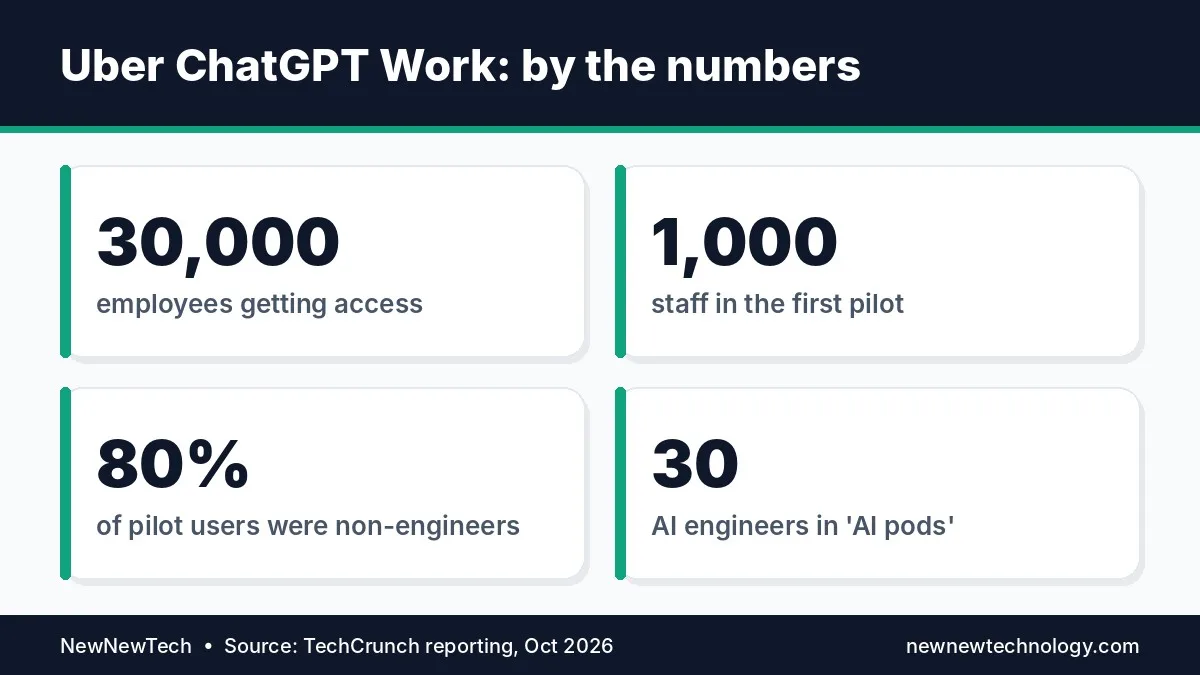
Uber also ran an experiment it calls "AI pods." It paired 30 AI engineers with teams across the company and gave them two weeks to automate key parts of a job. Sukumar said the pods showed how much opportunity appears when technical skill meets deep knowledge of a specific role.
How Uber Will Measure Success
Uber has not shared what the rollout costs. Instead, it plans to watch how people actually use the tool. The company will track which workflows employees build and whether those workflows help them work more effectively. Those results will guide how Uber deploys AI across the rest of the business.
This "experiment first, standardise later" approach is worth noting. Many firms do the opposite. They write strict rules up front, then wonder why adoption is low.
What the Uber ChatGPT Work Deal Means for Enterprise AI
The deal lands at a moment when OpenAI is pushing hard into business software. Once seen mainly as a consumer brand, OpenAI now competes head-to-head with Anthropic for enterprise customers. A 30,000-seat deployment at a global brand like Uber is a strong signal in that race.
It also arrives in a busy week for OpenAI. The company announced that its models are coming to Google Cloud and that it is reportedly raising up to $30 billion at a $1.25 trillion valuation.
| Stage | Users | Focus |
|---|---|---|
| Pilot (early 2026) | 1,000 | Test real tasks across departments |
| AI pods | 30 AI engineers + teams | Automate key job tasks in two weeks |
| Full rollout (Oct 2026) | ~30,000 | Open experimentation, measured outcomes |
Why It Matters
Most companies still limit AI tools to small groups. Uber is one of the first global brands to open an AI agent to every employee at once. If its results are strong, it will push other large employers, including outsourcing and tech firms in South Asia, to move faster. It also shows that AI value often comes from non-technical staff, not only from engineers.
Lessons for Businesses Planning an AI Rollout
- Start with a cross-functional pilot. Uber's best signals came from non-technical teams.
- Pair experts with domain teams. The AI pod model turned ideas into working automations fast.
- Measure workflows, not logins. Usage counts say little. Real time saved says a lot.
- Leave room to experiment. Rigid rules too early can kill useful discoveries.
Final Thoughts
The Uber ChatGPT Work rollout shows enterprise AI moving from pilot to default. The key lesson is simple. Give people a capable agent, watch what they build, and scale what works. Expect more large employers to follow the same path in 2027.
For more updates like this, browse our OpenAI News section.