

The OpenAI Decisions API is now available to every OpenAI customer. First announced at OpenAI's developer day on September 29, 2026, the service opened widely on October 22. It puts OpenAI squarely into a new and fast-growing market: decision models that make quick, cheap choices instead of writing long answers.
What Is the OpenAI Decisions API?
Think of a decision model as a super classifier. You give it a set of options. It picks one in a fraction of a second and tells you how confident it is. Developers have found these "System One" models can replace large language models in many workflows, at much lower cost and higher speed.
The category took off with Jev, a model from TypeSafe, a startup founded by a former OpenAI researcher. Jev's success helped make TypeSafe a $7.6 billion company.
How OpenAI Built It So Fast
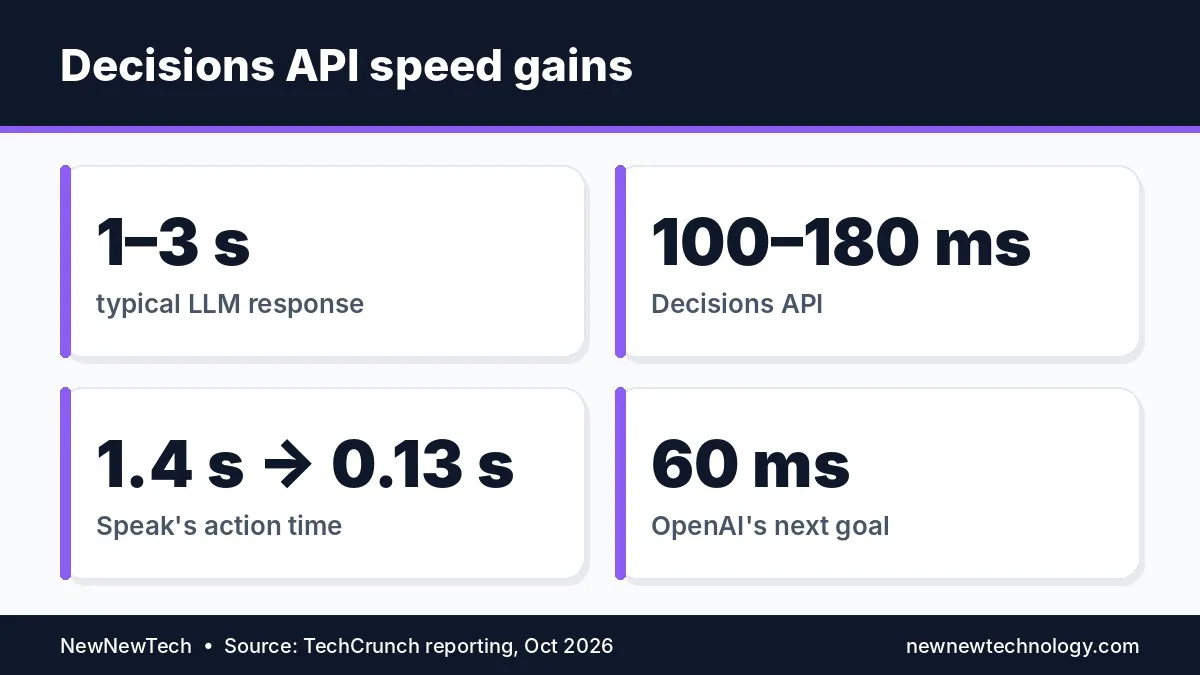
OpenAI did not train a brand-new model. Its API team took ChatGPT Luna and reconfigured it for faster inference and lower cost. Nikunj Handa, product lead for OpenAI's APIs, said the big unlock was speed, shrinking response times from one to three seconds down to about 100 to 180 milliseconds.
The public version adds voice and visual inputs. OpenAI also placed inference resources in regions around the world to lower latency for global users.
Real-World Results From Early Customers
- Speak, an AI language tutor, cut the time between actions from 1.4 seconds to 0.13 seconds.
- Box, Datadog and Ramp used it to replace slower LLM calls and boost throughput.
- OpenAI's own Dots voice assistant became more responsive using the API.
OpenAI Decisions API vs Jev and Other Rivals
Competition is intense. On public leaderboards, OpenAI is not yet on top.
| Model | Maker | Notable strength |
|---|---|---|
| D1 Ultra | Liquid | Leads several public decision benchmarks |
| Elephant-1 | Base Lab | Strong benchmark scores |
| Jev (latest) | TypeSafe | Most queried on OpenRouter; top of the JevMan Pac-Man test |
| Decision Model | OpenAI | Multimodal power, especially image classification |
On the AIM System One Index and Artificial Analysis Decision Index, Jev ranks seventh and third, while OpenAI's model ranks eighth and fourteenth. TypeSafe's CEO has urged developers to trust real-world trials over benchmarks.
Why It Matters
Many AI products feel slow because every step waits on a large language model. Decision models remove that delay for simple choices. Faster and cheaper calls mean AI can be used in places where it was too costly before, such as real-time voice apps, live moderation and high-volume support systems. For developers, the OpenAI Decisions API adds a strong option to a market that was dominated by startups.
Best Use Cases for Decision Models
- Routing support tickets to the right team.
- Content moderation and spam filtering.
- Real-time voice assistant turn-taking.
- Image classification in product catalogues.
- Game AI and other fast, repeated choices.
What Comes Next
Handa hopes to push speed to around 60 milliseconds, fast enough to run a call on every frame of a video. As decision models get cheaper, expect them to appear everywhere, much like the economist Jevons predicted when efficiency drives wider use. For another fresh model launch, see Canva Craft, Canva's first image model.
Explore more launches in our AI Model Releases section.