

Security teams around the world are rushing to patch PHP critical vulnerabilities that were uncovered with the help of frontier AI. On October 21, 2026, OpenAI shared details of a two-month global effort, run under its Patch the Planet initiative, to fix the flaws before attackers could use them. PHP powers a huge share of the web, so this one affects almost everyone who runs a website.
What Happened With the PHP Vulnerabilities?
Security firm Calif identified a critical flaw using OpenAI's GPT-5.6 Sol model as part of Patch the Planet. Cloud security company Wiz independently discovered and reported both vulnerabilities. PHP's own maintainers then led the fix and release.
OpenAI, Wiz, Cloudflare and others supported the response with research, technical help and coordination. They prepared protections such as web application firewall rules ahead of public disclosure. OpenAI calls this one of the most impactful security issues in recent memory.
Who Is Affected by the PHP Critical Vulnerabilities?
Any organisation running a vulnerable PHP version could be at risk. That includes many WordPress sites, custom web apps and shared hosting servers. The priority now is simple: apply the official fixes.
To help, OpenAI released a PHP version checker as a Codex skill. It helps operators find potentially vulnerable PHP versions so they can match them with the right updates.
How to Protect Your Website Right Now
- Check your PHP version on every server and hosting account.
- Update to the patched release listed in PHP's official guidance.
- Ask your host if you use shared or managed hosting. Many have already deployed mitigations.
- Enable WAF protections as an interim shield if you cannot update immediately.
- Use CISA's prioritisation guidance to decide between emergency patching and a planned update.
- Check for compromise if your systems were exposed, and confirm backups are working.
Why It Matters
PHP sits underneath a large part of the internet, from blogs to online shops and government portals. A single critical bug in such a widely used language can expose millions of sites at once. This case also proves that AI can now find high-impact flaws before criminals do, which changes how fast patches must be released and applied.
The "Defender's Window": Why AI Changes Security
OpenAI says frontier AI found these bugs before attackers did. That created what it calls a Defender's Window, extra time for maintainers to prepare fixes. But the company is also candid about the risk. The same AI that finds bugs can help attackers build exploits faster.
OpenAI expects similar findings to rise sharply in the coming months. To help defenders keep up, it has committed $1 billion in subsidised access to its Daybreak security tools for organisations with limited resources that protect essential services.
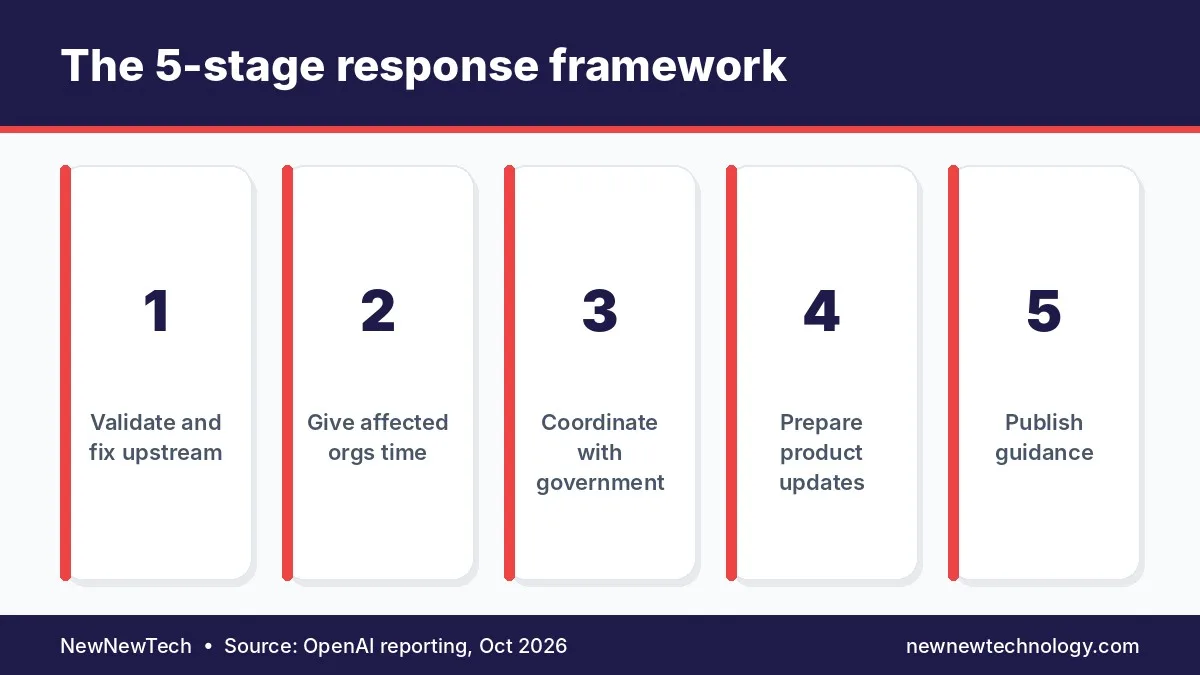
OpenAI's Proposed 5-Stage Disclosure Framework
| Stage | What happens |
|---|---|
| 1. Validate and fix | Maintainers and researchers confirm the flaw and test a patch, including adversarial AI testing. |
| 2. Give organisations time | Key distributors, hosts and security vendors get advance notice to prepare. |
| 3. Involve government | Agencies such as CISA and ONCD help reach critical infrastructure. |
| 4. Prepare updates | More vendors and operators ready patches across products. |
| 5. Publish guidance | Public advice helps everyone find, apply and verify fixes. |
OpenAI is asking the security community for feedback on disclosure windows, early notice and emergency patching.
Building More Secure Software Long Term
Beyond fixing single bugs, OpenAI points to four bigger goals: secure code from the start, migration to memory-safe languages, formal verification of critical components and stronger sandboxing. It also funds maintainers through Codex for OSS and project sponsorships.
Bottom Line
The PHP critical vulnerabilities are a wake-up call. AI is now finding serious bugs at internet scale. If you run PHP, patch today. If you build software, expect AI-driven security reports to become routine. For a related security tool, see how 1Password for Agents protects credentials from AI agents.
More updates are in our OpenAI News section.