
OpenAI models on Google Cloud are now officially on the way. On October 21, 2026, OpenAI and Google Cloud announced a partnership that brings OpenAI's frontier models and Codex agentic workflows into Google Cloud's Model Garden. For enterprise teams already building on Google's infrastructure, this removes a major hurdle.
Until now, companies that wanted OpenAI models usually had to go through OpenAI directly or Microsoft Azure. This deal gives Google Cloud customers native access in the environment they already use.
What the OpenAI and Google Cloud Partnership Includes
The integration has several parts. Each one targets a common pain point for large organisations.
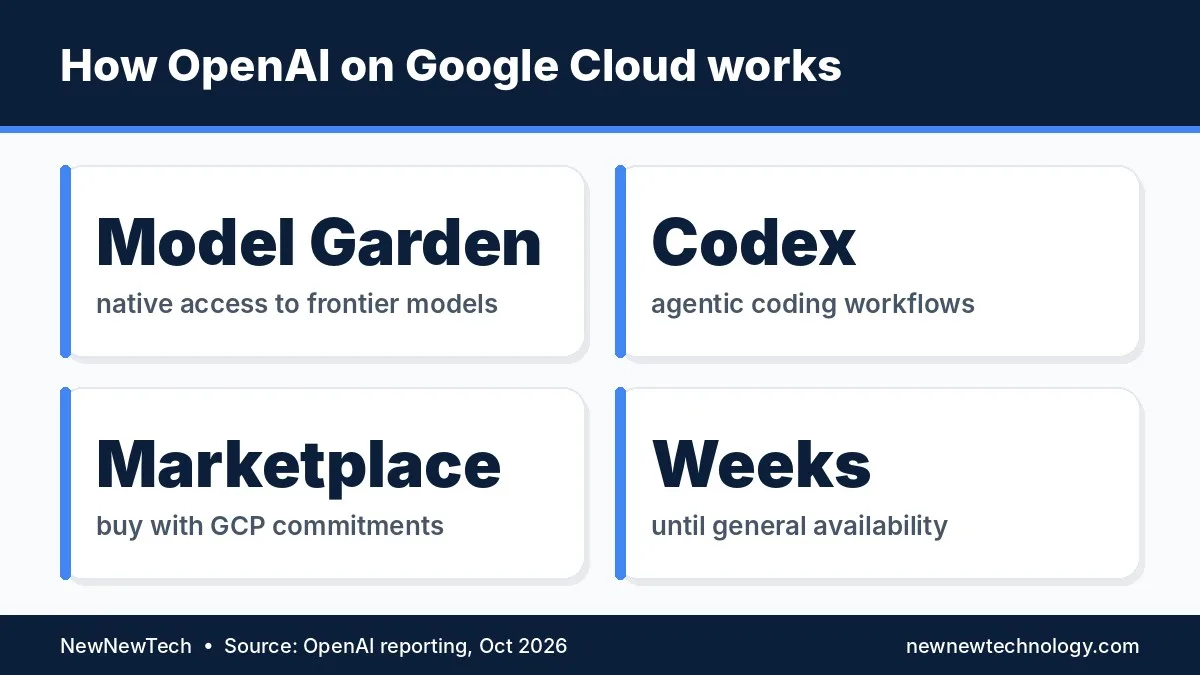
- Model Garden access: OpenAI frontier models will sit alongside other models in Google Cloud's Model Garden.
- Codex workflows: Developers get OpenAI's agentic coding tools inside Google Cloud.
- Marketplace billing: Purchases run through Google Cloud Marketplace.
- Commitment drawdown: Companies with GCP spend commitments can apply them to OpenAI usage.
- More surfaces soon: OpenAI models will also come to Google Antigravity and the Gemini Agent.
Why OpenAI Models on Google Cloud Matter for Regulated Industries
Banks, hospitals and government suppliers cannot simply send data to any API. They need strict control over who sees sensitive information and how it is used. OpenAI says the integration pairs its models with Google Cloud's built-in access controls, centralised data governance and high-performance infrastructure.
In plain terms, compliance teams can keep their existing Google Cloud security setup and still use OpenAI models. That can shorten approval cycles from months to weeks.
What Leaders Said
OpenAI President Greg Brockman framed the deal around meeting customers "where customers are already building." Google Cloud CEO Thomas Kurian stressed model choice, saying customers should be able to pick the right model for each job to improve quality and lower costs.
That message is telling. Cloud providers no longer compete only on their own models. They compete on how many top models they can offer in one secure place.
Does This Change OpenAI's Relationship With Microsoft?
OpenAI was clear on this point: Microsoft remains its primary cloud partner. The Google Cloud deal expands distribution rather than replacing Azure. OpenAI made a similar move earlier this year, letting customers access its models through Oracle cloud commitments.
| Question | Answer |
|---|---|
| Where do models appear? | Google Cloud Model Garden |
| How do I pay? | Google Cloud Marketplace, including GCP commitments |
| What else is included? | Codex agentic workflows |
| When? | General availability in the coming weeks |
| Primary cloud partner? | Still Microsoft |
Why It Matters
Cloud lock-in has been a real barrier to AI adoption. Many companies were forced to pick a model based on which cloud they used, not which model was best. By putting OpenAI models inside Google Cloud, this deal weakens that barrier. Businesses can now compare leading models side by side, keep their data in one place and pay through one bill.
What Developers and IT Teams Should Do Now
- Request access through Google Cloud if you plan to test OpenAI models there.
- Check how much of your GCP commitment is unused. It may now cover OpenAI usage.
- Run side-by-side tests in Model Garden to compare cost and quality across models.
- Loop in security teams early to map existing governance to the new models.
The Bottom Line
OpenAI models on Google Cloud signal a clear trend: frontier AI is becoming multi-cloud. Enterprises gain more choice and easier procurement. OpenAI gains reach. Google Cloud strengthens its pitch as the place to build AI agents. It is part of a busy week for OpenAI, which also saw Uber roll out ChatGPT Work to 30,000 staff.
Follow more updates in our OpenAI News section.