

Microsoft MAI-DxO has posted a striking result in medical AI. In a study published on October 22, 2026 in the journal Science, Microsoft's diagnostic AI solved difficult clinical puzzles at more than double the rate of general doctors. Mustafa Suleyman, CEO of Microsoft AI, called it a step toward "medical superintelligence."
What Is Microsoft MAI-DxO?
MAI-DxO (often shortened to DxO) is an orchestrator rather than a single chatbot. It runs a team of AI agents that act like a virtual medical board. One agent gathers the patient's history, another requests lab work, and the group argues its way to a final answer.
Key Results From the Science Study
The test set came from tough case reports published in the New England Journal of Medicine.
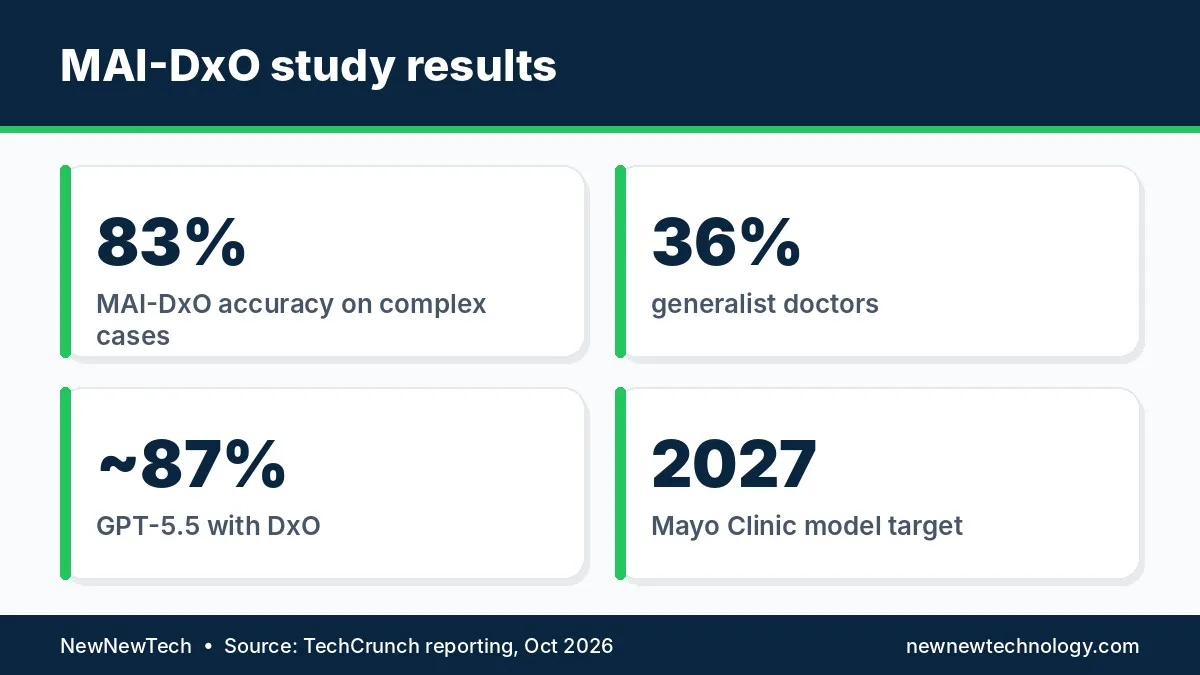
- MAI-DxO: correct 83% of the time.
- Generalist doctors: family doctors and internal medicine physicians, each allowed to consult references, reached the right answer in 36% of cases.
Keep one caveat in mind. In real hospitals, puzzles this hard usually go to specialists or multi-doctor teams, and no specialists took part in this test.
Is the Gain From DxO or From Better Models?
The study's own data suggests most of the improvement comes from more powerful base models. DxO adds gains on top. Microsoft tested models from OpenAI, Google, Anthropic, Meta and DeepSeek, and got its best results with OpenAI's GPT-5 and GPT-5.5.
| Setup | Complex cases | Emergency cases |
|---|---|---|
| GPT-5 alone | 78.9% (about $8,400 per case) | Little change with DxO |
| GPT-5 + DxO | ~4 points higher, ~$3,000 cheaper | Little change |
| GPT-5.5 alone | 72% | ~85% |
| GPT-5.5 + DxO | Nearly 87%, slightly cheaper | ~85% |
| Gemini 2.5 Flash | 46.4% alone, nearly 69% with DxO | — |
DxO helps most on complex cases and with weaker models. On emergency department cases, it added little. Microsoft notes that gains naturally shrink as models approach maximum accuracy.
Why It Matters
The world faces a growing shortage of doctors, especially specialists. A reliable AI second opinion could help general doctors catch rare or complex conditions earlier. At the same time, the study shows that results depend heavily on the underlying model, and simulation scores do not always carry over to busy hospitals. Real-world trials will decide whether this promise holds.
Real Hospital Trials Are Next
Microsoft is partnering with Beth Israel Deaconess Medical Center in Boston to test DxO in real hospital settings. Patients will receive standard care. Those who consent will also interact with DxO, and its recommendations will be compared with the doctors' decisions. Dominic King, Microsoft AI's VP of Health, expects it to be the biggest study of its kind.
Google recently published a similar real-world study of its AMIE diagnostic AI with Beth Israel in The Lancet.
Microsoft's Bigger Healthcare Plan
- A healthcare foundation model trained with the Mayo Clinic, planned for release next year.
- Medical record predictions: Suleyman expects a "coding-style breakthrough" for medical records in 2027.
- Clinical decision support: building on Microsoft's existing dictation and radiology tools.
Suleyman predicts healthcare models will become "an order of magnitude better" within 24 to 36 months.
What This Means for Patients and Doctors
AI is not replacing doctors tomorrow. But tools like Microsoft MAI-DxO could soon act as a second opinion for busy clinicians, especially where specialists are scarce. That could matter greatly in countries with too few doctors per patient. Strong oversight, privacy rules and real-world evidence will decide how fast it arrives.
Read more in our Microsoft AI News section.