
The DeepSeek $15 billion funding round is one of the boldest moves yet in the global AI race. Bloomberg reports that the Hangzhou-based lab has pulled in close to $15 billion (around 100 billion yuan), placing it among the largest private raises China has ever seen. The timing turned heads. Only 48 hours earlier, Washington had told non-military federal agencies to strip DeepSeek software out of their networks, citing security risks.
Who Is Investing in DeepSeek?
Names linked to the deal include battery maker CATL and WeChat owner Tencent, along with other backers. DeepSeek has not publicly commented yet, so the final line-up and amount could still shift.
DeepSeek $15 Billion Funding in Context: A Fast-Rising Valuation
This is not DeepSeek's first big raise this year.
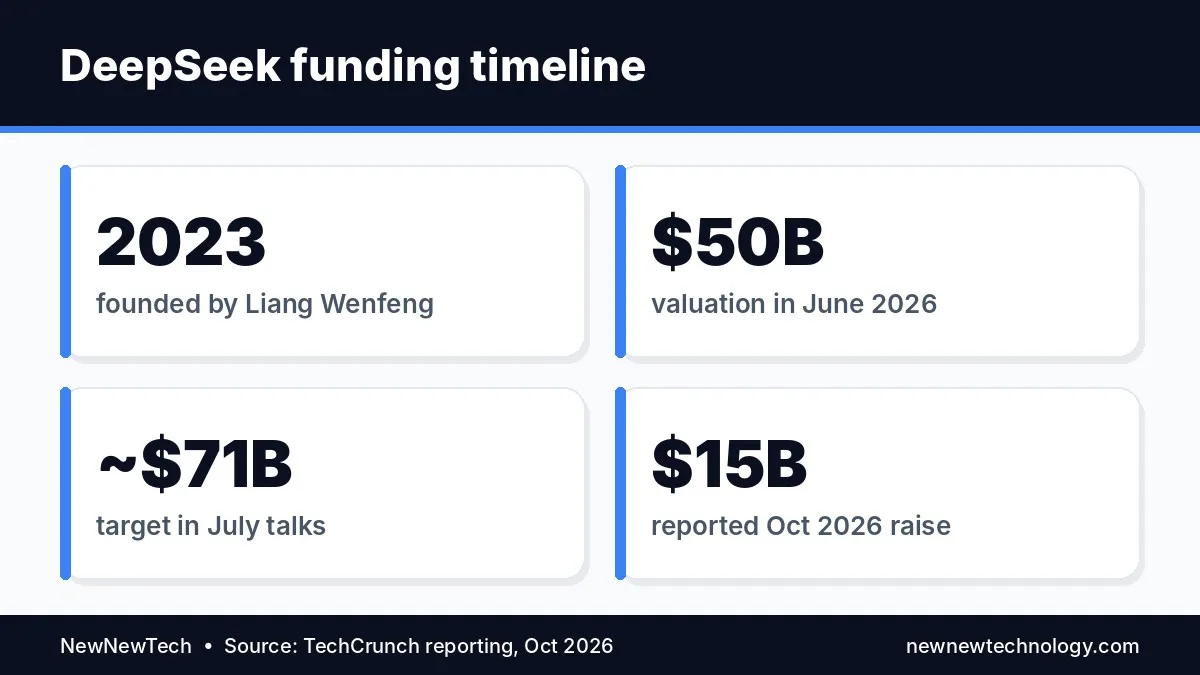
| Date | Event |
|---|---|
| 2023 | Founded by Liang Wenfeng in Hangzhou |
| Early 2025 | Free, open-weight R1 reasoning model gains global attention |
| June 2026 | Raised more than $7B at a $50B valuation |
| July 2026 | Reportedly sought $1.5B more at about $71B |
| October 2026 | Reported ~$15B round |
DeepSeek has also been linked to plans for a possible IPO in China as early as next year.
Why the US Restrictions Did Not Slow It Down
The U.S. move limits DeepSeek's use inside American federal agencies. But DeepSeek's core market is China and other countries that use open models. The lab is reportedly spending heavily on AI infrastructure and open models for both domestic and international users. Strong backing from Chinese industry giants shows investors are betting on that path regardless of Washington's stance.
Why It Matters
DeepSeek's open-weight models are used by developers worldwide because they are capable and cheap. Fresh capital at this scale means DeepSeek can keep releasing competitive models and pressure Western labs on price. It also shows that government restrictions in one country may not slow a company that has strong home-market support and global open-source users.
China's AI Funding Boom
DeepSeek is part of a wider wave of investment in Chinese AI:
- Moonshot AI, maker of Kimi, raised $2 billion at a $20 billion valuation in May.
- Manus AI raised more than $500 million earlier this month.
- Zhipu AI (Z.ai) and MiniMax went public in Hong Kong in January and are worth roughly $29 billion and $7.2 billion.
This new cash could intensify competition among China's domestic AI rivals.
Who Controls DeepSeek?
Founder Liang Wenfeng previously co-founded High-Flyer, a quantitative hedge fund that financed DeepSeek's early work. Corporate data analysed by WireScreen suggests Liang still holds an estimated 81.6% stake in DeepSeek's Chinese operating entity.
What It Means for the Global AI Race
- More open models: DeepSeek's funding may speed up free, open-weight releases.
- Policy split: The gap between U.S. restrictions and Chinese investment keeps widening.
- Price pressure: Cheap, capable open models push Western labs to cut costs.
Compare this with the reported OpenAI $1.25 trillion valuation to see how capital is flowing on both sides of the Pacific.
Conclusion
The DeepSeek $15 billion funding round shows U.S. restrictions are not stopping China's top AI labs from raising capital. For developers and businesses worldwide, that likely means more powerful open models and fiercer price competition in 2027.
Keep up with the latest in our AI News section.